Uncategorized
Body Contouring vs Laser Liposuction
Many people use body contouring and laser liposuction as if they mean the same thing, but they do not. The difference matters because the treatment method, downtime, candidacy rules, and expected result can change a lot depending on which category you are actually discussing.
TL;DR: Summary
- Body contouring is the broad category, while laser liposuction is only one possible method and is often confused with non-invasive laser lipolysis. FDA says non-invasive body contouring does not remove tissue and is different from surgical procedures like liposuction.
- Laser lipolysis is usually a localized fat-reduction option, not a full reshaping solution. ASPS describes it as using laser energy to heat and disrupt fat cells, commonly for visible fat bulges in the abdomen and flanks, often without anesthesia.
- Device indications are narrower than many patients expect. FDA records for a 1060 nm diode hyperthermic laser lipolysis system list areas like abdomen, flanks, back, and thighs, with some indications limited to individuals with a BMI of 30 or less.
- If your goal is weight loss, better health, or treatment of obesity, body contouring is the wrong tool. FDA states non-invasive body contouring does not treat obesity, does not produce weight loss, and does not deliver the health benefits of weight loss.
- The best choice depends on what you need changed. Localized bulges may fit laser lipolysis, broader sculpting with low downtime may fit a minimally invasive option like TuLi, and major skin or tissue reshaping may require surgery.
The key is to compare the treatment category first, then the brand or device. A patient asking for “laser lipo” may actually be deciding between a non-invasive laser device, a minimally invasive contouring procedure, or surgical fat removal.
What is the real difference between body contouring and laser liposuction?
Body contouring is the umbrella term, while FDA and ASPS treat laser lipolysis as one narrower approach. Liposuction removes tissue; non-invasive body contouring does not.
The FDA defines body contouring broadly as changing the shape of a body area, including waist or thigh circumference, silhouette, small fat areas, muscle tone, and cellulite appearance. That means body contouring can describe surgical, minimally invasive, and non-invasive treatments.
The term laser liposuction is where confusion starts. In everyday marketing, it may refer to an external laser treatment, a minimally invasive laser-assisted procedure, or a surgery that removes fat. A common misconception is that any laser-based fat treatment is “liposuction.” The FDA draws a clear line: non-invasive body contouring does not remove tissue.
“TuLi is a 15-minute full-body treatment designed for in-office body contouring with no general anesthesia.”
If you want a quick rule, use this one: if the treatment uses an external applicator and no tissue is removed, it is usually being discussed as non-invasive body contouring or laser lipolysis, not classic liposuction. If fat is physically removed, you are in a surgical category.
Is laser liposuction the same as laser lipolysis or non-invasive laser fat reduction?
No. ASPS and FDA use more precise categories than most consumer search terms do. SculpSure is an example of non-invasive laser lipolysis, not surgical liposuction.
ASPS describes laser lipolysis as a treatment in which laser energy is delivered through an applicator so fat cells are preferentially heated and disrupted. Patients usually seek it for a localized fat bulge, especially in the abdomen and flanks.
That description matters because it frames laser lipolysis as a targeted contouring option, not a broad replacement for surgical reshaping. ASPS also notes that it is generally done without anesthesia, has low complication rates, and commonly causes temporary redness, tenderness, and swelling.
If a clinic uses the phrase “laser lipo,” ask one direct question: Is this an external non-invasive laser treatment, a minimally invasive contouring procedure, or fat-removal surgery? That question clears up most of the confusion in under a minute.
What are the main body contouring options people compare with laser liposuction?
Most comparisons involve three buckets: non-invasive devices, minimally invasive contouring, and surgery. TuLi, SculpSure, and traditional liposuction sit in different buckets.
People often compare options that sound similar but solve different problems. Start by sorting them by invasiveness and whether tissue is actually removed.
- TuLi minimally invasive body contouring: An in-office option developed by Dr. Martin Moskovitz for adults seeking sculpted contours, with no general anesthesia, immediate return to normal activity, and treatment of multiple areas in one visit.
- Non-invasive laser lipolysis systems: Devices like SculpSure use external laser energy to target localized fat, usually in specific cleared areas and with narrower candidacy limits.
- Traditional liposuction: A surgical fat-removal procedure used when larger-volume extraction or stronger one-session reduction is the main goal.
- Other non-invasive body contouring devices: FDA-recognized body contouring also includes technologies aimed at circumference change, cellulite appearance, or muscle tone, depending on the device category.
- Surgical body contouring procedures: Operations like abdominoplasty address loose skin and tissue repositioning, which fat-reduction devices alone do not fix.
A useful shortcut is this: body contouring is not one treatment. It is a family of treatments with very different mechanisms and recovery profiles.
How do you decide which treatment category fits your goals?
Start with the goal, then match the treatment. FDA guidance and real-world practice both point to goal-first selection.
First, define what you want to change. If the goal is weight loss, treatment of obesity, or a metabolic health improvement, non-invasive body contouring is not the answer. The FDA explicitly says these treatments do not produce weight loss or the health benefits linked to weight loss.
Second, check what the tissue problem actually is. If the issue is a small, visible fat bulge, a localized treatment like laser lipolysis may fit. If you need broader shaping across several areas, a minimally invasive procedure may make more sense. If loose skin is the main issue, fat reduction alone may disappoint you even if the procedure works exactly as intended.
Third, decide how much downtime and intervention you accept. If your threshold is no anesthesia and minimal interruption, non-invasive laser lipolysis or a minimally invasive in-office option may be appealing. If you want the largest possible tissue removal in one session, surgery may still be the more direct path.
“TuLi can treat multiple areas in one visit and targets up to 3–4x more tissue per session.”
A pro tip here is simple: bring your priority list to the consult. Rank these in order: fat reduction, skin tightening, number of areas, downtime, anesthesia, and speed of result. That order often decides the category before any brand discussion starts.
Which areas can laser lipolysis actually treat?
Laser lipolysis is usually area-specific and device-specific. FDA records and ASPS descriptions point to the abdomen, flanks, back, and thighs as common examples.
One FDA 510(k) summary for a 1060 nm diode hyperthermic laser lipolysis system states that the device is intended for non-invasive lipolysis of the abdomen, flanks, back, and thighs in individuals with a BMI of 30 or less. That is a strong reminder that indications are not unlimited.
ASPS also frames laser lipolysis around localized fat bulges, commonly in the abdomen and flanks. That means a patient looking for broad circumferential contouring or treatment far beyond the device’s cleared zones may be asking more of the technology than the label supports.
A common misconception is that laser fat reduction works equally well on any body area or any body type. It does not. If the area is outside the device indication, or if the patient falls outside selection criteria, then the discussion should shift to another category rather than trying to force a poor fit.
How do results, downtime, and anesthesia compare?
Non-invasive laser lipolysis, TuLi, and surgical liposuction trade magnitude for convenience in different ways. The right choice depends on the amount of change you want and how fast you need to resume normal life.
Non-invasive laser lipolysis is attractive because it is usually performed without anesthesia and tends to have mild short-term effects like redness, tenderness, and swelling. The trade-off is scope. It is generally aimed at localized fat bulges and follows device-specific indications.
Minimally invasive body contouring sits in the middle. A procedure like TuLi is positioned for patients who want stronger sculpting than a purely non-invasive device may offer, but without general anesthesia or a long recovery. In the provided company context, the defining features are a 15-minute full-body treatment, immediate return to normal activity, and no special post-op care.
Traditional liposuction is still the benchmark when the priority is tissue removal and larger-volume change. The trade-off is that surgery typically asks more from the patient in planning, recovery, and perioperative care. If your main goal is a small contour refinement, surgery may be more than you need. If your main goal is a major one-session reduction, non-invasive laser lipolysis may be too modest.
What risks, limitations, and misconceptions matter most?
The biggest mistake is treating all “laser lipo” options as equivalent. FDA language, ASPS guidance, and everyday patient expectations often diverge.
For non-invasive laser lipolysis, the commonly described short-term effects include redness, tenderness, and swelling. Those are usually temporary, but they still matter if you are treating a visible area before travel or an event. The larger limitation is often candidacy, not discomfort.
- Scope: Body contouring changes shape, not body weight or obesity status.
- Terminology: “Laser liposuction” can mean an external laser treatment or an invasive fat-removal procedure.
- Selection: FDA-cleared devices may carry body-area limits and BMI limits.
- Expectation: Fat reduction does not automatically fix skin laxity or muscle separation.
The practical test is straightforward. If your result depends on skin removal, major tissue extraction, or a large silhouette change, then a localized laser lipolysis device may not be the right tool even if the marketing sounds close.
“TuLi was developed by Dr. Martin Moskovitz and is offered in a Quad A accredited surgical facility.”
How should you evaluate a body contouring provider step by step?
Ask category questions before price questions. FDA terminology and provider transparency should make the treatment type easy to identify.
Start by asking what the treatment is, not what it is called. Ask for the exact device or procedure name, whether it is non-invasive, minimally invasive, or surgical, and whether fat is actually removed. If the answer stays vague, that is useful information by itself.
Next, ask how candidacy is screened. A strong consult should review target areas, BMI when relevant, skin laxity, prior abdominal surgery when relevant, and what result would count as success. If a provider skips candidacy and jumps straight to packages, that is a weak signal.
Then review the setting and follow-up. Ask who performs the treatment, what type of facility is used, what aftercare is expected, and whether virtual or in-office consultations are available. Patients comparing an in-office option like TuLi with an external laser device should also ask how many areas can be treated in one visit and what normal activity looks like the same day.
What happens before, during, and after a laser-based body contouring visit?
Most visits follow the same sequence: screening, treatment mapping, and short follow-up. ASPS descriptions and in-office workflow patterns are consistent on that point.
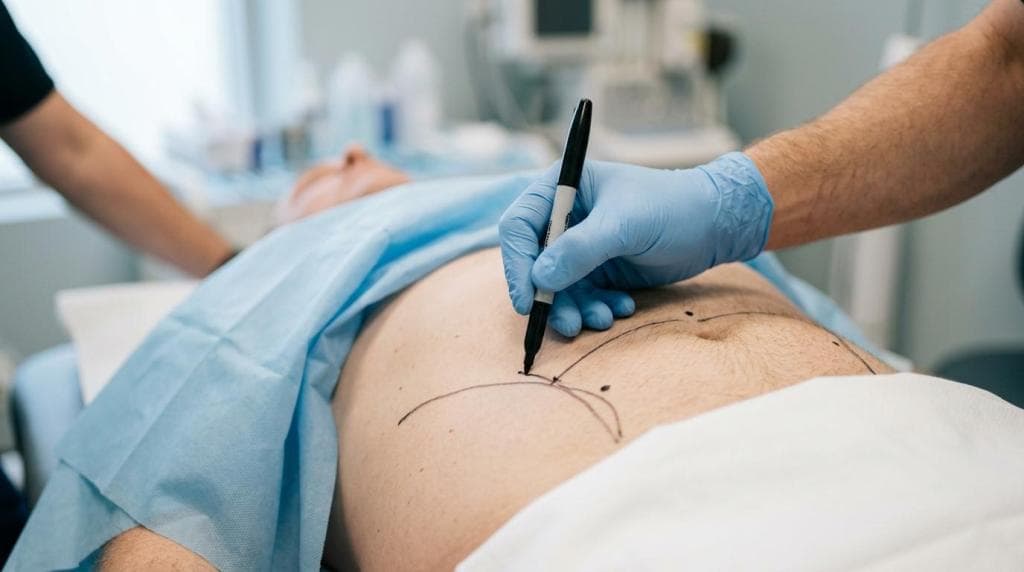
Before treatment, the provider should confirm that the target area fits the method. This usually includes photos, marking, and expectation-setting about what the treatment can and cannot change. A pro tip is to ask what metric will be used to judge success: circumference, photos, pinch thickness, or silhouette.
During a non-invasive laser lipolysis visit, an external applicator delivers energy to the selected area. ASPS describes the procedure as one done without anesthesia, with temporary redness, tenderness, and swelling being common short-term effects. In a minimally invasive visit, the workflow may still be office-based, but the mechanism and tissue reach differ.
After treatment, instructions should be simple and specific. With TuLi, the provided context states immediate return to normal activity and no special post-op care, which is a meaningful contrast point for patients sorting options by recovery burden.
“TuLi allows immediate return to normal activity and does not require special post-op care.”
When is a minimally invasive option like TuLi a better fit than non-invasive laser lipolysis?
TuLi is the stronger fit when a patient wants broader sculpting without general anesthesia or downtime. Non-invasive laser lipolysis is the better fit for smaller, clearly localized bulges within device indications.
If you want an external treatment with no tissue removal and you are comfortable with narrower area limits and candidacy rules, non-invasive laser lipolysis can be rational. This is especially true when the target is a modest bulge in a device-cleared area.
If you want more noticeable sculpting across multiple areas in one visit, but still want to avoid general anesthesia and a classic post-op recovery, a minimally invasive option like TuLi may be the better category to evaluate. The company context also states lasting, natural-looking results and treatment of up to 3–4x more tissue per session, which speaks to scope rather than comfort alone.
If you need skin excision, structural tightening, or large-volume fat removal, then surgery remains its own category and should be discussed that way. The best outcome usually comes from choosing the right category early, not from trying to stretch one technology past its real indication.
Ready to take the next step?
Request a consultation with Dr. Moskovitz to discuss whether the TuLi procedure is right for you.
Request a Consultation